

Welcome back. We thought turkeys could fly. Our bad.
We’re changing the usual order this issue because the General Assembly is in its lame duck (which also can’t fly) session and two bills dealing with Flock cameras are sitting in the House. One of them would rewrite the public records exemption for license plate reader data, so we’re starting there. After that, the Ohio Supreme Court decides a records fight that grew out of last year’s viral brawl in downtown Cincinnati. Our body camera story comes from Massachusetts, where officers on a well-being check found a neighboring town’s police chief in a liquor store parking lot. And the Q&A comes from a records technician who thinks one of her most frequent requesters might be an AI bot.
Off we go!
Lame Duck Session Watch: Flock Cameras
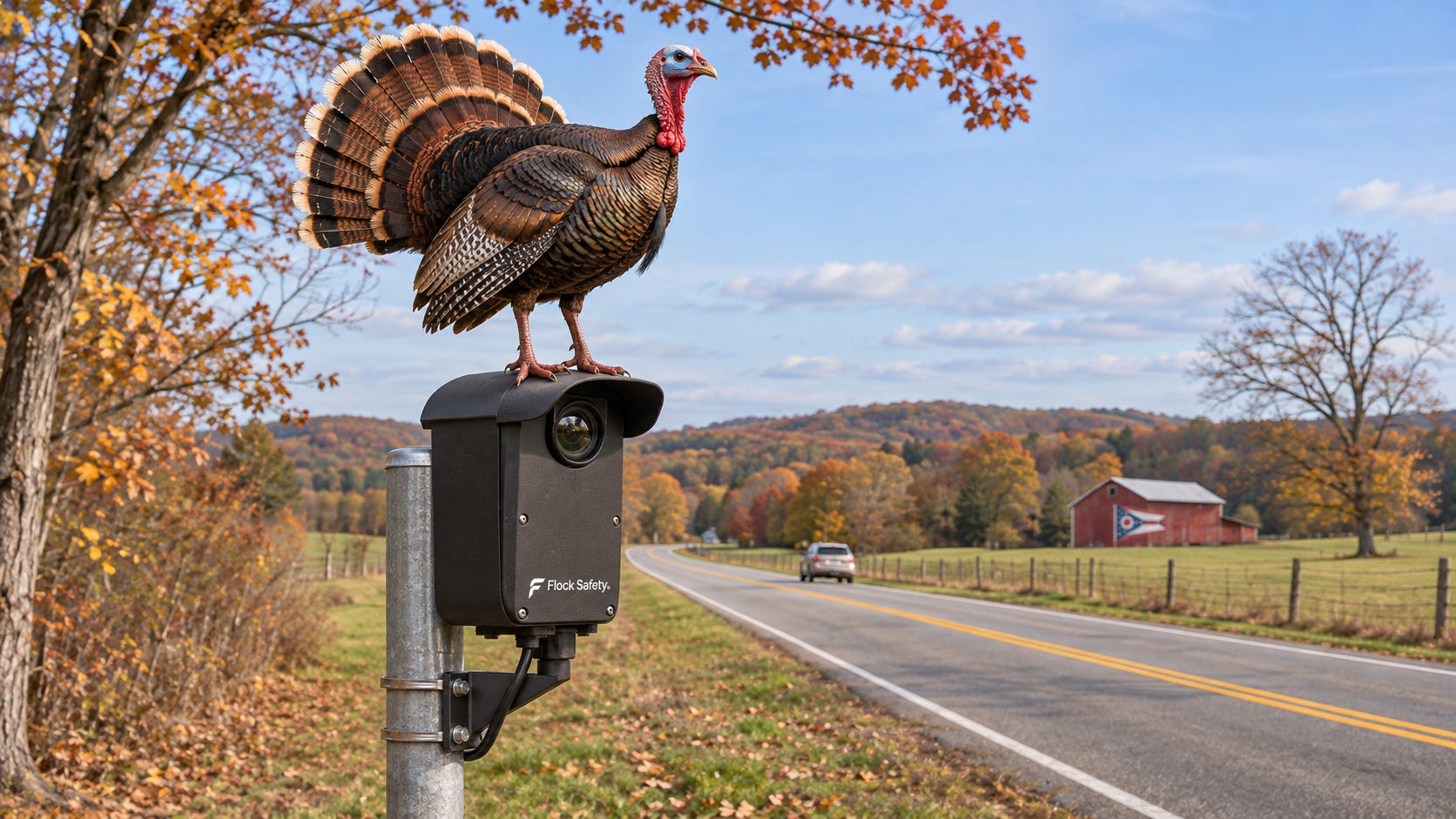
Ohio lawmakers have until December 31 to pass anything that’s still pending, and whatever doesn’t make it has to start over with the new people in January. Two House bills on license plate readers are pending, and only one of them has a real chance.
House Bill 725 is the one to watch. Rep. Kevin Miller of Newark introduced it as a short bill restricting the commercial sale of plate reader data. A substitute version is now in front of the House Public Safety Committee, and it reportedly does a lot more.
We haven’t seen the text of the substitute bill. It isn’t posted on the legislature’s website, so for now we have to take the word of the witnesses who testified about it.
According to that testimony, the substitute adds limits on how long plate reader data can be used and kept, makes knowing misuse a fifth-degree felony, and requires every agency using plate readers to adopt a written policy that includes internal audits.
The witnesses also say it changes the public records exemption. Right now, R.C. 149.43 exempts “images and data captured by an automated license plate recognition system that are maintained in a law enforcement database.” The testimony says the substitute expands that to cover “inquiries or searches” of the data.
If the witnesses have it right, that would settle the audit log question we’ve answered a dozen times this year. We’ve said the current exemption doesn’t cover a log of who searched the system, and that the better answer is Huwig, since you don’t have to run a database export to create a record that doesn’t already exist. Under the language the witnesses described, search logs would be exempt. We’ll report back once we can read the bill ourselves.
The bill had its fourth hearing on November 17. Every major law enforcement group testified for it. The ACLU of Ohio and a number of residents opposed the public records piece. You’re shocked, we know. They argued that search logs are how misuse gets identified.
The other bill is House Bill 1010, from Rep. Levi Dean of Xenia, which would ban government use of plate readers almost entirely. It hasn’t had a hearing, and we don’t expect it to get one, much less pass.
Nothing has changed yet, so keep answering Flock requests under current law. If your department uses plate readers and doesn’t have a written policy, start thinking about one now. HB 725 reportedly requires one.
Per usual, if you have opinions on legislation, call or email your State Representative or State Senator and speak up!
Court Case Review
State ex rel. Utz v. Cincinnati, 2026-Ohio-3805 (Supreme Court of Ohio)

You probably remember the video. On July 26, 2025, a brawl at Fourth and Elm in downtown Cincinnati went viral and made national news. One of the men in the footage, Alexander Tchervinski, was beaten during the fight and was later charged with misdemeanor disorderly conduct himself. Within days of that charge, the city solicitor’s office asked the municipal court to restrict public access to the case file, reportedly citing Marsy’s Law because Tchervinski was also a victim. The court set a hearing for Monday, September 8.
